Thus, mortification is not punishment, but purification. Fasting is not deprivation, but preparation. Discipline of the body is not contempt for creation, but reverence for its proper order.
In the same manner, obedience to parents and teachers—especially in matters of studies, entertainment, habits, alcohol, drugs, and relationships—is not a burden meant to oppress, but a form of loving guidance meant to strengthen. Just as the Heavenly Father permitted His Son to fast forty days in the wilderness to prepare for His saving mission, so also parents, out of love, set boundaries for their children to secure their future good. Loving restraint today forms steadfast character tomorrow. Therefore, it is wise to embrace discipline in youth, for it builds the strength needed to face the trials and changes of the future. A heart trained in self-control grows in purity, perseverance, and courage. And a life shaped by obedience and sacrifice becomes pleasing in the sight of God our Father, who desires not our hardship, but our holiness and eternal joy.
Mockery of our faith in Christ
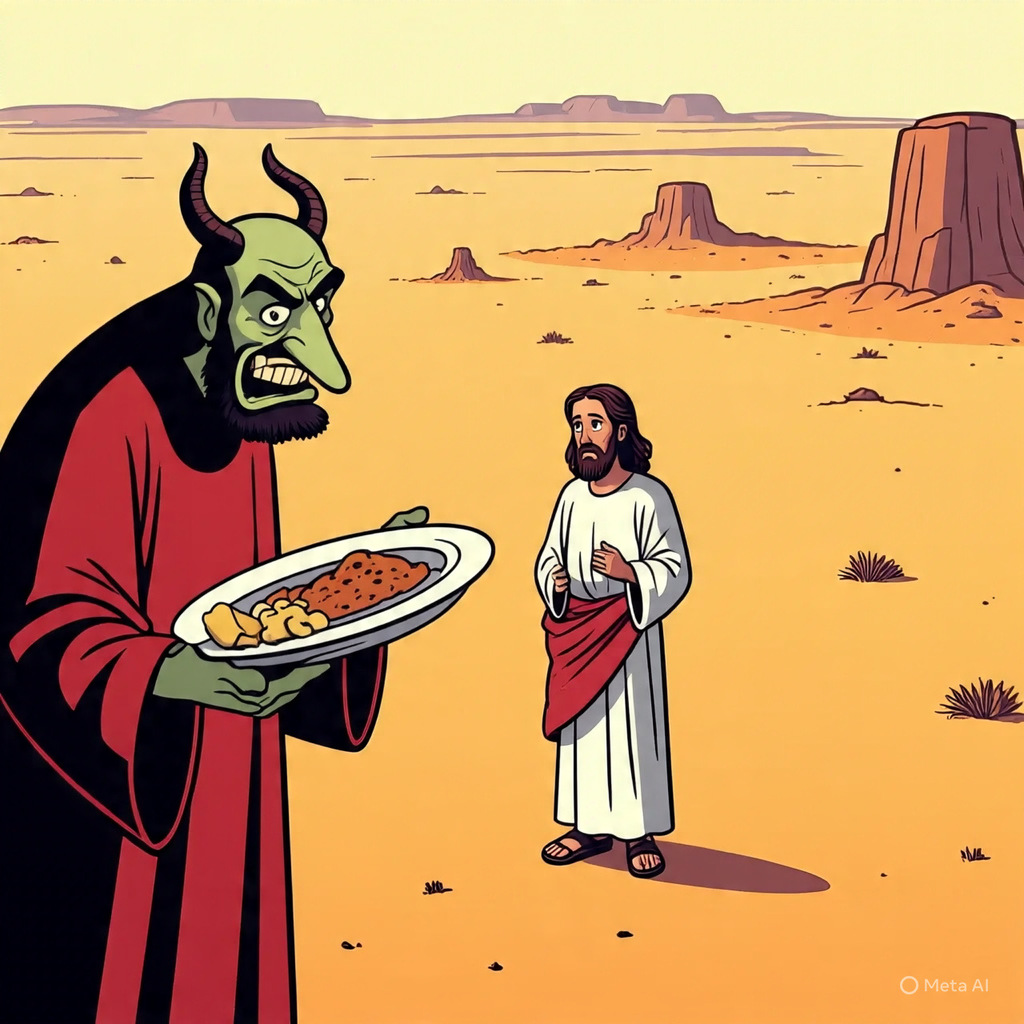
In the Gospel, we see the devil tempting Jesus to throw Himself down from a high place so angels would catch Him. The devil even quotes Scripture to sound convincing: “He will command His angels concerning you… they will lift you up in their hands” (Matthew 4:6; Psalm 91).
But this temptation wasn’t really about angels. It was about distraction.
Jesus already knew who He was — the Son of God. He didn’t need to prove it. The devil knew it too. That’s why earlier he said, “If you are the Son of God, command these stones to become bread” (Matthew 4:3). The enemy wasn’t questioning Jesus’ identity; he was trying to pull Him away from His mission. Instead of choosing the path of sacrifice and the Cross, the devil tempted Jesus to show off His power. He twisted it to sound spiritual: “If God loves You, prove it.” But Jesus responds firmly: “You shall not put the Lord your God to the test” (Matthew 4:7).
The devil’s strategy hasn’t changed. Today, he may not ask us to jump off a cliff. Instead, he whispers: “It’s normal. Everyone is doing it. It’s not a sin anymore.” But just because something is popular doesn’t mean it is right. The Bible reminds us, “Do not be conformed to this world, but be transformed by the renewal of your mind” (Romans 12:2). God’s truth is not decided by trends, votes, or what’s common. It is eternal.
Anything that pulls us away from God’s will, weakens our faith, or damages our body and soul is not from Him. As Scripture says, “Be sober and vigilant. Your adversary the devil prowls around like a roaring lion, seeking someone to devour” (1Peter 5:8).
Like Jesus, we are called to stay focused on our mission. We don’t need to prove ourselves to the world. We just need to trust the Father, resist temptation, and choose what is right — even when it’s unpopular.
Success without pain (Why Carry The Cross And Follow Jesus)
It’s interesting to notice that during the temptations of Jesus, the devil clearly knew who Jesus was. From the earlier temptations, he understood Jesus’ identity as the Son of God and also His deep love and obedience toward the Heavenly Father. Yet he still dared to show Jesus all the kingdoms of the world and claim authority over them. Imagine the boldness of that moment—the devil showing the Creator His own creation and offering it back to Him, if only Jesus would bow down and worship him.
But why would the devil attempt something like this when he knew that Jesus is “the Word” through whom everything was created? “In the beginning was the Word… Through Him all things were made.” (John 1:1–3)
The reason is that although Jesus is the Son of God, when He came to earth He chose to live fully as a human being. He set aside His divine privileges in order to become one among us. That is why throughout His ministry we see Him praying, fasting, and depending on the Father. He lived this way to set an example for us to follow.
The devil understood that Jesus was living as a man, and so he tried to exploit His human weakness. He knew that Jesus would regain His glory after fulfilling the Father’s will on earth. But that path involved suffering, rejection, and the pain of the Cross. So the devil presented a shortcut. Instead of obeying the Father and going through the suffering of the Cross, Jesus could simply worship the devil once—and instantly gain power, glory, and authority over the earth.
In other words, the devil was saying, “You don’t have to suffer. You don’t have to go through the Cross. I can give you everything right now.” But this was nothing more than a deceptive lie, just like the lies he spoke from the time of Adam. “For he is a liar and the father of lies.” (John 8:44) Jesus immediately rejected the temptation and drove the devil away with the truth of Scripture: “You shall worship the Lord your God, and Him only you shall serve.” (Matthew 4:10)
Today the devil may not ask us to bow down and worship him directly. Instead, the temptation comes in subtle and disguised ways. We are often encouraged to worship success, fame, money, or power. Instead of trusting in God’s grace, we sometimes hear messages like:
“Believe in your own power.”
“Trust the universe.”
“Positive vibrations will guide you.”
“The cosmos will align with your will.”
Many of us have heard statements like these. But we must be careful. These ideas slowly shift our focus away from the Creator to the creation. Our God is not an impersonal force or energy. He is a personal, loving God who desires a relationship with us. The moment our attention moves from God to created things, we become spiritually vulnerable.
Choosing the Right Path - God is our Creator, and we belong to Him alone. The devil has no authority over us unless we choose to surrender our will to his temptations. That is why he constantly tries to entice us with attractive offers and shortcuts. Deep down, every human being longs for lasting happiness and peace. Jesus teaches us that the path to true life is not always easy. “The gate is narrow and the way is hard that leads to life.” (Matthew 7:14)
The devil, however, offers a fake alternative path—one that looks easy and appealing at first but ultimately leads to darkness and sorrow. True peace comes only from God. “For to us a child is born… and He will be called the Prince of Peace.” (Isaiah 9:6). Living with Integrity - Whether we are in school, college, or at work, we must learn to pursue success with honesty, discipline, and faith. Shortcuts that compromise our values may bring temporary success, but they never bring lasting joy. Jesus reminds us with these powerful words: “What does it profit a man if he gains the whole world, yet loses his soul?” (Mark 8:36)
Even when the journey feels difficult, we should place our full trust in God and keep moving forward. He will never abandon us. “Trust in the Lord with all your heart… and He will make your paths straight.” (Proverbs 3:5–6) When we walk with Him, He holds our hand, guides our steps, and leads us toward true and eternal happiness.